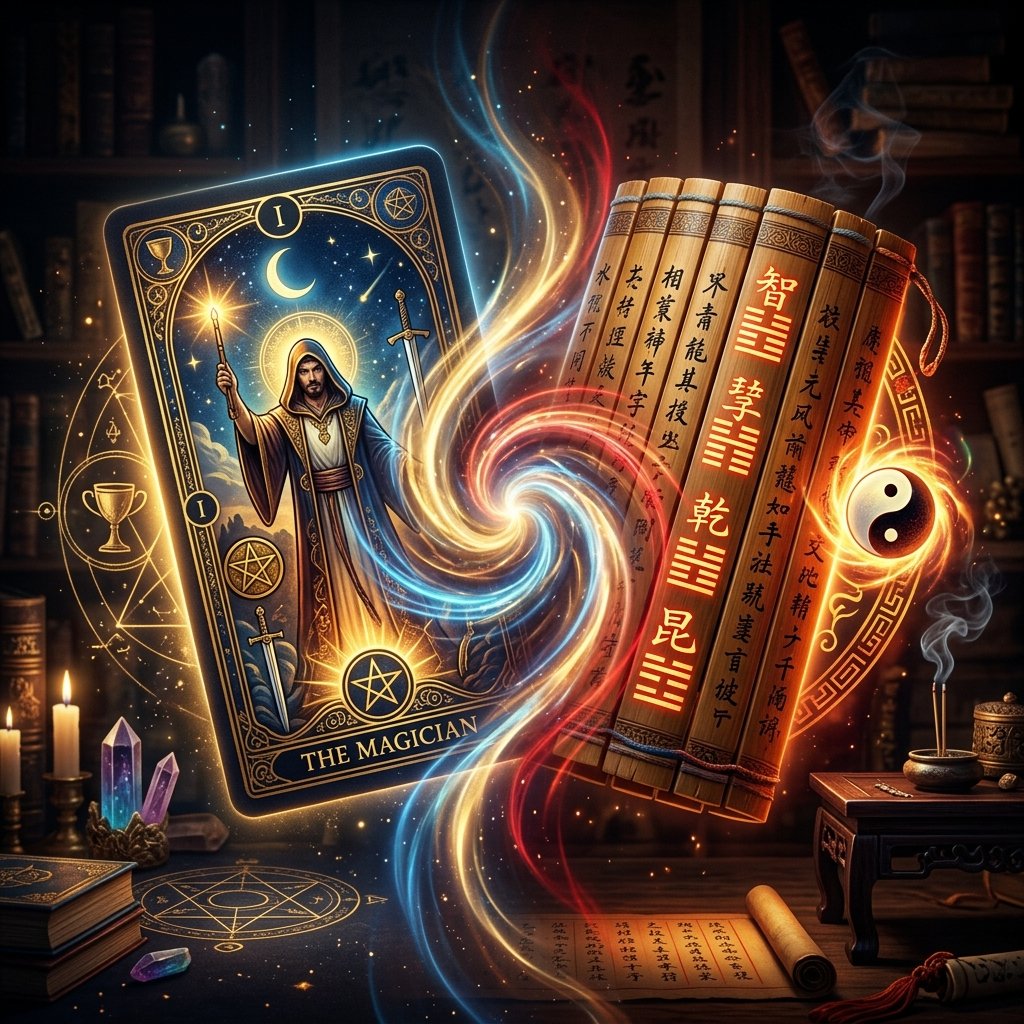
When seeking answers from the universe, you have two primary streams of esoteric wisdom: the intuitive imagery of Western Tarot, and the structural hexagrams of the Eastern I Ching (Book of Changes). While they originate from opposite sides of the globe, they both serve as powerful mirrors for the subconscious mind.
Table of Contents
The Tarot Approach: Visual and Intuitive
The Tarot deck consists of 78 cards, divided into the Major Arcana (the soul’s journey) and the Minor Arcana (everyday events). Tarot speaks the language of archetypes and imagery. When you pull the “Death” card, you don’t need a manual to feel the heavy energy of transformation and endings.
Tarot is highly subjective. The meaning of a reading often depends heavily on the intuition of the reader and how the specific imagery of the cards interacts in a spread.
The I Ching Approach: Elemental and Structural
The I Ching, which forms the philosophical basis for BaZi and Feng Shui, is entirely different. It consists of 64 Hexagrams, each made of six broken (Yin) or unbroken (Yang) lines. It speaks the language of nature and energy dynamics (e.g., Water over Fire, Wind over Mountain).
The I Ching doesn’t rely on visual intuition. It relies on mathematical probability (traditionally cast with yarrow stalks or coins) to determine exactly how the Yin and Yang energies of your current situation are shifting.
Which One Should You Use?
Use Tarot when you need to understand the emotional or psychological landscape of a situation. It is unparalleled for exploring relationships, feelings, and the hidden motivations of yourself and others.
Use the I Ching when you need strategic, philosophical advice on how to act. The I Ching will not tell you how someone feels about you, but it will tell you whether it is the right time to advance, retreat, or hold your ground.
Frequently Asked Questions
Can I use Tarot and I Ching together?
Absolutely. Many modern practitioners pull a Tarot card to understand the emotional state of a problem, and then cast an I Ching hexagram to determine the best strategic action to take.
Do Tarot cards have bad energy?
No, Tarot cards are just printed paper. They act as a mirror reflecting your own subconscious or the current energetic trajectory. “Scary” cards like The Devil or The Tower simply represent necessary structural changes or attachments.