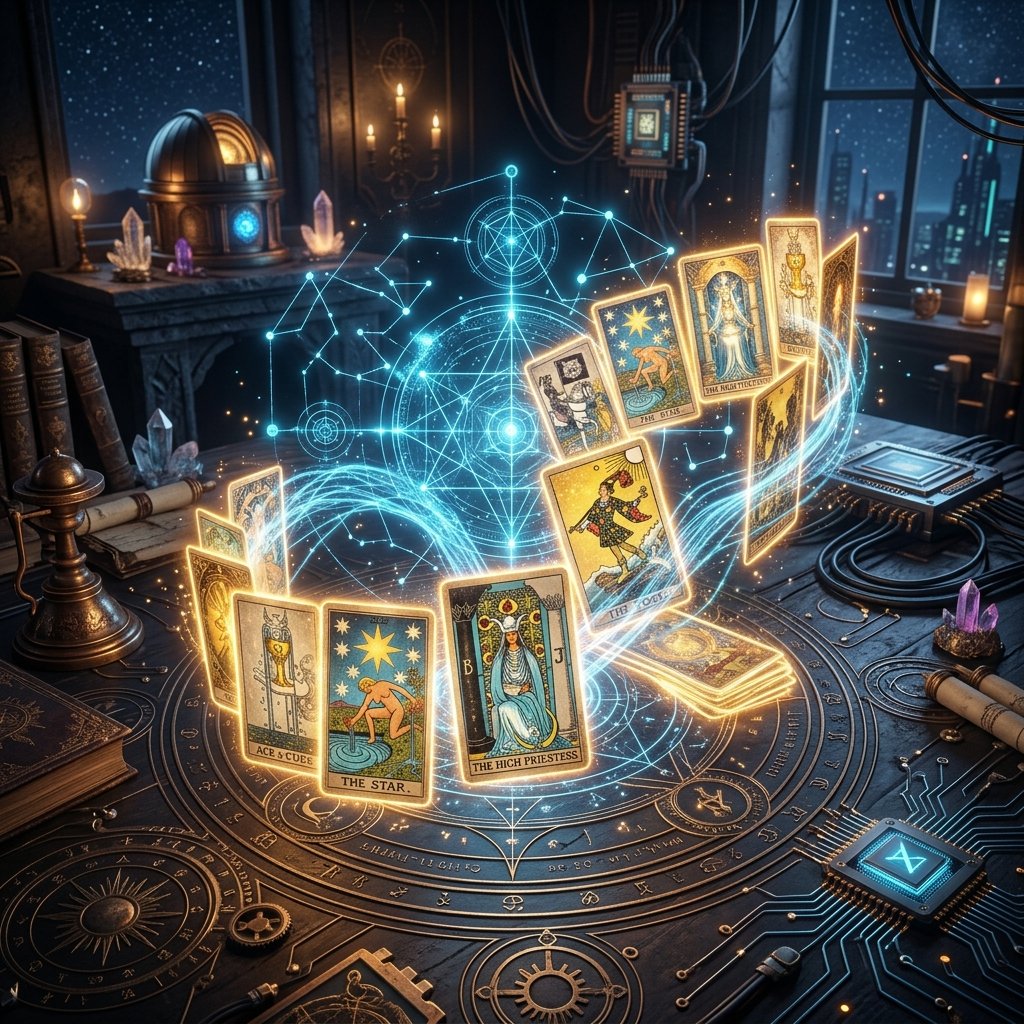
When people think of Tarot, they usually picture a mystic shuffling physical cards in a dimly lit room. So, when AI Tarot readers were introduced, many were skeptical. How can a computer possess intuition? Surprisingly, users report that AI Tarot readings are eerily, shockingly accurate.
Table of Contents
The Concept of Synchronicity
Carl Jung coined the term “Synchronicity” to describe meaningful coincidences. Whether a human shuffles a physical deck or a Quantum Random Number Generator (QRNG) selects a digital card, the underlying philosophical principle is the same: the universe aligns the output with the energy of the question being asked. In fact, cryptographic RNGs used by advanced AI are often more truly “random” than human shuffling.
How AI Understands Archetypes
Large Language Models (LLMs) are trained on vast datasets encompassing thousands of books on psychology, mythology, and esoteric Tarot lore. When an AI analyzes a spread of cards (e.g., The Tower and the 3 of Swords), it instantly cross-references millions of contextual archetypes, synthesizing an interpretation that is incredibly deep, cohesive, and devoid of the “cold reading” tricks some human readers use.
Frequently Asked Questions
Can AI predict the future with Tarot?
Tarot is not meant to predict a fixed future; it reads the current energetic trajectory. AI is exceptionally good at analyzing current variables and highlighting the most probable psychological or material outcome if you stay on your current path.
Is an AI reading less spiritual than a human reading?
Spirituality is about the connection to the self and the universe. If the message provided by the AI resonates deeply and provides you with clarity and healing, the medium delivering that message (silicon vs. human vocal cords) is secondary.